Monday, August 29, 2016

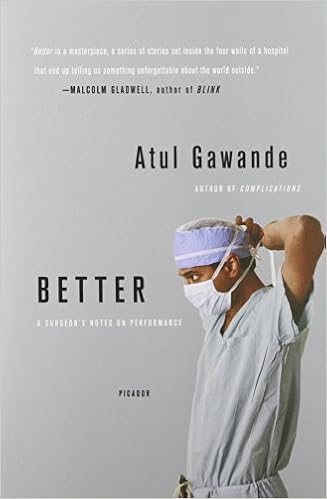
Summer Reading: Better: A Surgeon’s Notes on Performance by Atul Gawande

Image via Amazon.com
I am heading into the second year of my grad program in school leadership (read: Administration). We were asked to read Atul Gawande's Better: A Surgeon’s Notes on Performance. After everything I have been through over the last 3 years including weight loss surgery and the ensuing massive weight loss, thyroid cancer, vocal cord paralysis and surgery to help the paralysis, and surprise gall stones that led to numerous medical challenges between Thanksgiving and the end of the school year- and lots of trips to the ER and yet one more surgery...it was a difficult book for me to read. However, it left me with lots of ideas and thinking about systems, methods, and how to do things better.

There were so many moments that stood out: 
“We want doctors to push and find a way...We also want doctors to fight even in the most mundane of situations.” (160) and “At some point you have to admit that you are up against a problem you are not going to solve and that, by pushing further and harder, you might well do more harm than good.  Sometimes there is nothing you can do.” (163)
but the following is the reflection I wrote to submit for my class, reflecting on some of the more poignant ideas for me, as educator and not surgeon. 

Better: A Surgeon’s Notes on Performance by Atul Gawande took me a long time to read. Not because it was a challenging read, but because it was triggering for me on many levels.  I know “triggers” is a word that is thrown around these days, but it was a good reminder for me that many things we read bring things up for the reader, triggering emotions, memories, and thoughts about things that have happened in their lives.  The lens with which he examines practice and performance is medicine and my overabundance of medical procedures over the last three years as left me in a somewhat delicate place.  Despite all the triggers, I found many pieces of thinking and insight he offered applied to my own work and evolution as educator and leader.

To start, Gawande writes,“...diligence stands as one of the most difficult challenges facing any group of people who take on tasks of risk and consequence.” (29) There have been countless times that I stepped in front of a group-- students or adults,  and felt as if I was taking a huge risk.  The stakes are often high: trying a new teaching method or activity, presenting a way of thinking to a group to try in their own classrooms, discovering along with students instead of going in with all the answers, and in an age of high stakes testing, exams that must be passed to graduate.  Diligence is defined as, “careful and persistent work or effort” this is exactly what is needed in order to create and define a school community.  This act of diligence couples with the risk is as the forefront of what is needed for leading and running a school. Inquiry should drive understanding and thinking at multiple levels of education.  “Sometimes, however, we will be wrong...We each should then be prepared to accept the consequences.   Above all, we have to be prepared to recognize when using our abilities skilfully comes into conflict with using them rightly.” (153) and “...the hardest part of being a doctor...is to know what you have power over and what you don’t.” (154) Substitute doctor for ANYTHING.  It is true.  Knowing what we have power to control and what we don’t is a lifelong quest to understand.  As educators we often work to control all the pieces.  This is why lesson plans are often overly structured- school leaders want teachers to anticipate all the possible variables, especially early in their careers, that could happen in their classes.  I have found so much power in not knowing all the answers and being able to say to students, I am reading this with you for the first time.  Let’s see where it takes us.  There will absolutely be failures and times when we are wrong.  But, as school leaders, turning to teachers and teachers leaders to set the same example can be essential.  

Even in trying new things, working to be somewhat transparent, developing systems, asking teachers to take risks and go on the journey with you, and hoping failure isn’t inevitable, the following still holds true:
...the natural pull of conversational gravity is toward the litany of woes all around us. But resist it. It’s boring, it doesn’t solve anything, and it will get you down.  You don’t have to be sunny about everything.  Just be prepared with something else to discuss: an idea you read about, an interesting problem you came across… (253)
This is perhaps some of the best advice, especially for teacher leaders who are working with younger teachers or teacher teams. School communities can quickly become toxic, an us vs. them, or a sinking ship that sometimes schools can begin to resemble. Having the ability to steer the conversation towards a new idea, a problem of practice, or even a positive exchange with a student can make all the difference in the development of community within schools.

Finally, “...discover the unexpected.” (252) Learning is about discovery.  When we already think we know all the answers, the space for cultivating new thinking and perspectives can and will be lost.  Being open to possibility should be at the core of all that we do.

Sunday, July 24, 2016

Leadership: Thinking About Support

As teachers, we often ask questions that we already know the answers to.  It is part of the planning process to anticipate what might be confusing and how we will navigate said confusion with questions to help students navigate through and ultimately come out the other side with a new sense of what they think, believe or even feel about a topic.

Next month, I begin the second year of the CLASS program at Hunter College facilitated by New Visions for Public Schools. I am studying to earn my SBL license.  As a result, I often find myself thinking about leadership and management.  Last night, I was sitting around with family.  Both my parents are now retired.  Some how we got onto the topic of: what makes a good manager.  I already knew the answer to the question I was going to ask, but I asked it any way.  What do you need from a manager in order to do your best work?

The first part of the answer I got was what I expected, because it is what I always want. It's about autonomy.  As employees, we want to be trusted to do the work we were hired to do because as managers or supervisors, we believe that you hired us because we are the best at what we do and that is why we are there to do it.  You would have hired someone else if that was not the case.  Micro-management undermines the relationship and leads to distrust and frustration, on both parts.  Employees, just like kids, need to have success and failure in order to grow and develop.  We need to be trusted to learn from our experience, reflect and evolve.


The second part of the response was a good reminder.  When I have a question, because there is something I may not know, or need clarification about, be available--as a manager, with an answer and a good one at that.  Even if the manager does not know how to do every job of every person working for them. (I am a big fan of collaboration and brining in people who are experts in their field to do the things that I can't.  This is how I learn and get better and as a teacher, how my kids learn!  This is why the arts has Professional Teaching Artists).  Being available and being a part of solving what ever the problem is ends up being good for the employee and even better for the company.

As I go into year two of thinking and learning about leadership and management, I will work to remember these two things because I already knew they were they answer, it's simply up to me to act on it.

Sunday, May 15, 2016

I Did It - CSNYC CS Pedagogy Meetup!


I was asked this year to present a workshop at the CSNYC CS Pedagogy Meetup, a monthly meeting of educators and others to hear about and discuss the things that are afoot in the CS teaching world.  Now you may be thinking to yourself, why is Meredith there?  Doesn't she teacher theatre and English?  Its true, I do but I have been working on creating interdisciplinary learning experiences for my 9th graders that use the tools they are learning in their CS class (Scratch) to explore the content we are covering in theatre.  While I knew I was not going to be the big draw of the morning, I had a great group of about 10 educators who stayed to hear about my work, try and few things out and talk about how they can bring collaboration and innovation to their own teaching and learning communities.  I also got some great ideas about how to use some of the things I am doing to teach sequencing when we are exploring narrative.

Overall, a very positive morning.  Thanks to Maor, Sean and CSNYC.


Saturday, April 30, 2016

Day 30: What #Aprilblogaday Challenge Gave Me

Take Aways: New thinking about yourself and/or your craft after completing the April Blog A Day Challenge

Image via HERE

This is my second year doing the April Blog A Day Challenge.  Last year, it came just a few weeks after I had undergone major surgery to remove the cancer from my body.  It was a scary time and having the space to write and reflect, to focus on my work and think about the hows and whys of my craft were a welcome distraction.  I didn't think that this year I would be facilitating this journey for others.  I wish I has been able to get more people involved.  I pitched to the staff of 50+ teachers at my school and while in theory teachers want to do this kind of work, making time to write and reflect in this way is a big ask of oneself when already feeling overwhelmed with the work to be done.

Ultimately, I am glad I took this on.  I wish I had pushed harder, dig deeper.  I also valued the insight that the small group of bloggers brought to the conversations.  As always the thinking of teachers challenges me to look more closely about how and why I do things. This exercise is invaluable and makes me a better teacher and educator.

Things I want to take back to the staff and administration as part of the larger conversations to be had.

Reflection must happen intrinsically. 

At the end of each lesson plan and unit plan we write at my school there is a space for reflection.  I seldom complete this step. It's not because I don't want to. It's because time keeps ticking and there is always something new to be done. It's difficult for teachers to slow down and really reflect on what is happening in their classrooms.  


Teachers don't learn how to "reflect" and as a result don't learn how to look at student work and data. 

I remember, that the beginning, the talk was data, data, data.  I got frustrated because I was expected to just know how to look at what students were doing and 1. Generate "data" for administration to assess and 2. Use the "data" to inform instruction.  While the phrase "checks for understanding" has become mainstay in teacher talk, truly understanding what the checks tell us is something learned over time and with experience.  

Two weeks ago I facilitated a protocol for examining student work to inform instruction.  I asked two co-teachers to examine the work from one class.  Using a common system of evaluation, they graded, then divided the work up into 4 quartile.  We then moved through a process of examining the 2 lower quartiles.  The process took about an hour and in the end I was able to support teachers in developing a deeper understanding of where their students are, the next steps teachers need to take for strategic interventions (to address misunderstanding of methods or content). 

In their reflection on the protocol teachers wrote:

Image via HERE
"I also liked reviewing the work with my co-teacher because it gave us step-by-step instructions and we were able to do some great analysis of student work and see where students did well and where we need to re-teach or re-focus."

"I really liked the SLIP protocol because it allows me to see which of my students are struggling in common areas. It might have been nice to have access to both higher and lower level students in the comparison to see if there is a common hole in knowledge/skill throughout the whole class which would point to a flaw in instruction."

I am glad my team was able to go through this process.  We had to carve out the time to make it happen.  If administration wants to get the most out of teachers there must be time to do this kind of work.  It needs to be supported and facilitated by more experienced teachers who can help guide the process until teacher teams can take it over on their own and self direct.

Friday, April 29, 2016

Day 29: Teacher Appreciation Week! #AprilBlogADay


-->Prompt: Teacher Appreciation Week is coming up. (May 2-6)- 
How do you celebrate your work and the work of your colleagues? 


Image via Ms. Lombardo
One of my favorite people, Kathleen, who also happens to be an amazing 8th grade teacher, posted a photo of herself on Facebook yesterday sitting in a GIANT beach chair. (Does spring break really have to end?!)  In the comments I wrote, "Edith Ann!" realizing after the fact that she may have no idea who I was talking about.  I had not thought about Edith Ann in years and then this morning as I was doing a little research for this blog post I came across this quote:

 "I like a teacher who gives you something to take home to think about besides homework."  
~Lily Tomlin as "Edith Ann"

 This is so, so true.  As we head into teacher appreciation week it is important to thank teachers for their work and commitment to thinking. My favorite and best teachers challenged my thinking about what I was learning.  For me, every day I step into my own classrooms, I hope that I have created learning experiences that not only push the thinking of my students, but challenge my own thinking on a topic. 

This year, I would like to thank the teachers who so publicly document their journey.  Your journey through education provides insight for all of us and teaches us how to be better teachers.  I would like to thank my AP Lang Facebook group, an amazing collection of teachers who are innovating and challenging, creating exciting learning experiences for students.  I often read their posts and feel so, so inferior but then I am reminded that I am at the beginning (this is only my second year teaching AP Lang) and that I have so much to learn.  Their willingness to share and teach their colleagues is inspiring.  While we don't all agree with everything that is being done, in the end, it is about the kids.  This group epitomizes that ideal. 

I hope this week you all find time and space to thank your own teachers, your children's teachers and your colleagues.  I know for me, I don't need gifts.  Thank yous are enough.  There is nothing better than a note of thanks.  Take the time, write someone who has inspired you and thank them for their service to education and to learning. 

Article: What Do Teachers Really Want For Teacher Appreciation Week? (HuffPost)

NEA Website: 


Edutopia

Thursday, April 28, 2016

Day 28: Why Teach? WHo would be crazy enough to do that? #aprilblogaday


-->Prompt:  Would you encourage young people to consider the field as a profession?
Image Via schoolsweek.co.uk


Every teacher has seen lists like this one in the HuffPost titled "21 Reasons To Quit Your Job And Become A Teacher" (2013) I, like many teachers here in NYC, am a career changer.  I started grad school in the fall of 2006 at the age of 29.  There were not any fancy incentives for me becoming a teacher.  I don't teach math or science and I am not a special education teacher.  I am a run of the mill English teacher.  What makes me a little different is that I am also a theatre teacher.  I am licensed in both subjects.  I also has a successful career as a theatre professional before moving to teaching. I didn't become a teacher because I couldn't DO what I intended to in my first career.  I became a teacher because I wanted to (and I have already established how selfish teaching is).  It was my evolution. 

I often tell my students is that one of my biggest priorities as their teacher is to make sure they know how to learn independently from me.  My best teachers gave me freedom to discover what I loved and the space to explore that passion.  While school is very different than it was when I was in school, this is still my goal.  I want my kids to leave my room as independent and confident thinkers, researchers and challengers of scholarship.  A sense of inquiry is essential to growth.  My students hopefully go on to college and careers confident and ready to take on anything they are presented with. 

Becoming a teacher--and working as one-- is an investment in both time and money.  I often joke with my kids that I have a MA from NYU instead of children.  In NY one must ultimately have at least a Masters degree to continue teaching. (You can start with a Bachelors degree.)  I also tell the kids though, that education is the best way to invest.  It can not be foreclosed upon. The debt has been worth it.  The journey is worth it.  

If you are not sure about teaching, don't start there.  Do what you think you want to do.  Try it.  See how it goes.  Then if you still want to teach, you will find your way.  

For my friends who like data, here are some numbers for you...


In NY State (2011-2012)

Total Teachers: 241,000 

Percent of teachers, by highest degree earned

Less than a Bachelors - 2.8%
Bachelors - 4.4%
Masters -  84.2%
Education specialist  or doctor's -  8.6%

Percent of teachers, by years of full-time teaching experience
Less than 3 - 5.3% 
3-9 years - 30.0%
10-20 years - 45.5% 
Over 20 - 19.1%

Average Class Size
Elementary 20.7
High School 25.2

Note: I have no fewer than 30 kids in each of the classes I teach.  The biggest is 34, the cap here in NYC.  I did teach in an alternative high school where my average class size was about 20.  That was ideal.

We need teachers.  We need strong, confident people of all backgrounds to teach and lead in schools.  It is just that simple.  Do it.


Wednesday, April 27, 2016

Day 27: Rejuvenation! #AprilBlogADay Challenge

-->Prompt: Continuing: how do you keep stretching and learning over the summer?
Image via HERE
My happy summer place!

 I love summer.  My birthday is in August and I am a true summer baby.  Growing up in Seattle, summer was the pay off for so many months of overcast skies, gloom, and wet.  When it finally came it meant late nights at the park, wondering around the neighborhood with the plethora of kids I grew up with, and swimming in the lakes. It was a different time.  As I get older I am thankful for my 8 weeks off each summer. It is a time for R&R- Rest and REJUVENATION! I have sought out opportunities for me to learn.  Last summer I took an eight week memoir writing class at NYU School of Professional Studies. The summer before I took the College Board AP Summer institute (APSI) Workshop for AP English.  This was only a week.  The summer of 2013 I was accepted at The Cullman Center Institute for Teachers at the NY Public Library for a week long writing intensive with John Wray. These bursts of creative work and learning inspire and rejuvenate me each summer.  I like to be busy.  I like to think.  I like to create.  I thankfully have been able to find opportunities to do all those things each summer.  My husband and I also usually go away for a week to the shore.  Last summer we had a place with a pool.  It was my happy place!

This summer, I have some lofty goals.  Well, I have ONE goal: to pump out a draft of my memoir.  It is not about teaching.  For me, it is good to write about other things.  It is good to talk about my journey, which you can read about on my other blog.  I also get to go to Seattle for 10 days, one of which is for my 20 year high school reunion.  :-)  High school is never too far from my brain. 


My Advice: Do things you love in the summer.  Spend time with people you enjoy.  Eat food you love.  Sit outside in the morning and enjoy the quiet and the light (and that you are not going to work).  Drink cold beverages in warm weather.  Stay up late.  Challenge yourself.  Find creative outlets.  Rejuvenate.


Dear TeamTowne Advisory... or Wonder Women: The End of a Era

To My Wonder Women... Advisory is a double edged sword.  There are wonderful things like: community and friendship, built in support mech...