Tuesday, January 19, 2016

Defense of Learning: Portfolios- Day One

Today was the first day of the oral Defense of Learning portfolio presentations.  I had to teach first period and I didn't get quite as many mentors/adults in to sit with groups, however in the end it was ok.  Day one was a success.  

Students came in dressed to impress, some in suits and ties others in dress pants and button downs.  It was clear that they meant business.  All I had given them going into today was the groups they would be presenting in.  They all had to be ready to go.  For the most part, they were.  Only a few students did not have hard copy of their portfolio-- the document that I collected at the end of the period.  All did however have their presentations ready and 14 students presented to panels of peers and adults today, justifying the grade and level of mastery they believe they have demonstrated for the semester.

In groups of 5, they sat around, some choosing to stand in front of their group and began.  Each student had 10 minutes to present their defense and then had an additional 5 minutes of questioning from the panel about their defense.  At the end of the 15 minutes, presenters stepped into the hallway to wait while the panel engaged in discussion of the effectiveness of their defense, looking at the presentation as well as the hard copy portfolio.

As a teacher, moments like this are always a risk.  Trying something new, being the first in my school to toss out numerical grades all together and ask students to rely on feedback alone to evolve and learn.  Risk aside, it is also exciting.  I know that they are growing but to learn it through reflection and analysis has proven to be far more effective than any feedback I could have written on a report card.  Today was an exceptional example of student ownership of learning.  


My principal, Seung was able to come in for part of the presentations today.  As a former English teacher himself, he has a clear understanding of the work and of the steps to move students at this level.  Shortly after his visit he sent out the following emil to the staff: 

Staff,

Today I had the privilege of observing students in the AP Language and Composition presenting their Defense of Learning about their performance of the Mastery Skills they are expected to work on in the class. 

I listened to Colin and Mamadou give their presentation to their peers and articulate their rationale of their level of performance and was privy to Vanaija, Bujar, and Nicholas discussing and evaluating Mamadou's presentation. Needless to say, I was so impressed with the student-led, student driven conversations and discussions that cognitively challenged and engaged every student in the class.... 

This is why we moved to Mastery-based learning and a wonderful example of what students can do when given the opportunity to take control of their learning. 

Congratulations to Meredith and her class on such an impressive display of intellectual discourse. 

It is true.  Last year and throughout the summer when I began to dig deep into Mastery learning, I came to believe that there are no half-measures when it comes to learning this way.  I know that this choice with my AP class, while challenging and far from perfect is on its way.  Tomorrow will be day two of presentations and then I will conference with students on Thursday and Friday to determine final semester grades.  When we come back after the Regents week I will debrief with students to determine what worked, what didn't and how we can make it better for second semester.

Saturday, January 16, 2016

Defending Learning: The Big Push

It's Saturday morning and I am sitting in my classroom in Union Square waiting for a little more than half of my AP students to descend on my classroom for three hours of portfolio prep.  I picked up bagels and cream cheese, have fortified myself with an egg and cheese wrap, and my coffee awaits in my travel mug.  I am hoping for an epic morning of work.


I returned to work on Wednesday of this last week after a prolonged illness and unanticipated surgery- not once but twice right after new years.  I had a very different vision for what January was going to look like in my classes, but sometimes our bodies make different choices for us.  I was reminded that I do no good for my students if I am not healthy.  While I have had more challenges than many in the last two years, my students are what bring be back again and again.  While at the end of the day Friday, I was exhausted physically, mentally I was feeling better.

Tuesday will kick off the two-day portfolio extravaganza: AP Language and Composition - Defence of Learning.  I have invited mentors as well as teachers to sit in on panels to hear the oral defense and evaluate student arguments.  This is the FIRST time we are trying this as I continue to push forward with the #TTOG Mastery Learning Pilot at AFSE.  I created THIS DOCUMENT to help guide the panel in their participation and feedback for presenters.  Students have been told that professional attire is required and that no, sneakers don't count.  (Though having been to Facebook offices here in NYC, CS crowd tends to dress down.) "But I only own gym clothes, Miss."  It's time for my kids who are 6 months from senior year to Bare Down and Step-Up.

Thinking good thoughts for today and for next week.  It will be a crazy 4 days- then State Common Core English Exam the week after.  Fingers crossed!


Wednesday, January 13, 2016

Defending Learning: First Semester Portfolios- Kickoff (or Best Laid Plans...)

Image via HERE

As teachers we always have the best of intentions.  I know I do.  When I began the #ttog grading pilot in September I had lots of big lofty goals about what it would do for student learning and thinking about work in my class (AP Lang).  I don't know that I have had the buy-in that I had hoped for.  My 11th graders have rolled with it, indulging me and my big ideas as I try and wrap my mind and teaching around mastery based learning and going grade-less in high school.

There are a few things that are clear to me as I approach mid year:

  1. I need better mechanisms for giving students feedback on their writing.
  2. While my year long standards are great- and the rubrics I have designed actually are sound language they don't work in the day to day work for offering feedback and I need to work with students to create more "actionable" language that identifies the skills that go with standards and how to indicate where they are on a spectrum of mastery.
  3.  I need to let go of the larger reading and writing goals I may have had (reading a book a month and writing a rhetorical analysis of it) and modify- selecting shorter pieces that are read and analyzed through similar process. 
  4. Blogs ARE the way to go.  The work and transparency and access it provides for students has been exciting and inspiring.  When students go back and look at the work they have done this semester, hopefully (!) they will see growth from September.
All said, I have to work within the constraints of the public school system and this means awarding numeric grades at the end of the semester that will go on their semester report card and official transcripts. I created what I call a Defense of Learning (Check it out and let me know what you think!).  It is what AP Lang is all about: demonstrating how to use language to make a rhetorical appeal to a specific audience and persuade them to see things the way you do.  

I may have been overly ambitious- but we will see.

Today will be my first day back since students began the work last week for medical reasons, however I have high hopes and I am excited to see the work they are doing and thinking that is driving their DoL.

To be continued...

Friday, December 11, 2015

When CS Meets Theatre Arts or That Time I was In The New Yorker

Earlier in November I was interviewed by the talented writer Betsy Morais, a member of the editorial staff at The New Yorker Magazine.  She was doing a piece for the Talk of the Town section of the historic magazine about Mayor Bill de Blasio announcement that computer science education would be in all schools, at every grade level, within the next 10 years. We spent a few hours together at a CSNYC Meetup, coordinated by Sean Stern, my colleague at AFSE. I was able to tell her a little bit about the project I was working on that resulted in the following piece:  "Can an English Teacher Learn to Code?"  The answer is: YES!  Not very well yet, but I am learning to use Scratch.  It was such an honor to be in The New Yorker and I think she captured me well.  Funny thing was, the day of the interview, it was the first day of the flu that plagued me for a week.  I was just happy I came across slightly coherent.

The interesting thing is- the unit I am in the process of designing and implementing is a theatre unit. While I am also an English teacher, I am a drama teacher too.  I am a proud alumna of NYU's Educational Theatre program and (University of Arizona's Theatre Production BFA program).  Theatre is in my blood.  I will be the first to say that Scratch, while foreign, clicked (pun intended- make sure you check out Scratch). When I did the boot camp Sean set up last spring, my mind began racing about ways to integrate this into content classrooms.  Theatre is what came to mind first.  I began developing the unit this summer and into the fall and last week, my two blocks of 9th graders (about 60 kids) began the first two parts of the unit.  They were assigned brief scenes from movies - having just finished Shakespeare monologues- all movies that are kid friendly and have some great teen characters to portray. The first two steps are to work on character development, and to put the director hat on for the first time and begin creating stage pictures using blocking notation.  For these classes I am calling it "theatre code" as to work to bridge the gap between theatre and Computer Science. 

Today we spent the period with one of the two blocks in the theatre on campus, just playing and rehearsing and continuing to create blocking for their scenes.  It is exciting to see them start to make connections and start to create truly authentic scenes.

The next steps will be to do the paper prototyping step where they will create a flip book of every movement the characters make and how long it will take for each character to make the movement.  How fast are they talking/walking? I am excited to see how their work continues to develop and evolve through the end of the month and into January.  They will begin Scratch when we come back from the winter break.  Can't wait.

Any thoughts? Ideas? Insight?  Feel free to let me know!


Saturday, October 24, 2015

Can You Hear Me? Thinking About Women and Rhetoric

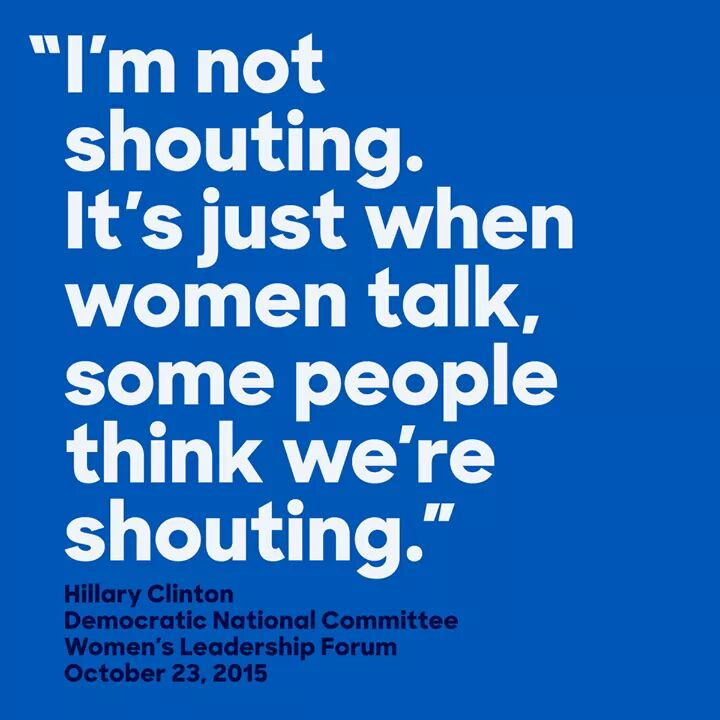
I was on Facebook this morning and I teacher friend of mine had posted the following image from Hillary Clinton's Facebook page:

Photo Credit: Hillary Clinton (Facebook)
It made me laugh because yesterday had been, as it is each Friday, discussion day in AP Language and Composition.  It is a day I always look forward to and the 11th graders challenge me, make me mad, and engage in amazing conversations about a multitude of topics and readings.  This week they had read and analyzed The Declaration of Independence (you might have heard of it) and a lesser known document known as The Declaration of Sentiments by Elizabeth Cady Stanton. The Seneca Falls Keynote Address was given July 19, 1848 more than 60 years before women's suffrage would finally achieve one of his greatest goals in getting the 19th amendment to the constitution passed and guaranteeing women the right to vote.   It includes lines like this:

The history of mankind is a history of repeated injuries and usurpations on the part of man toward woman, having in direct object the establishment of an absolute tyranny over her. To prove this, let facts be submitted to a candid world.
Teaching in a STEM school with 75% boys, I tend to push the lens of gender and rights issues more than I might if the scales were more balanced.  It's fascinating to watch their thinking challenged and shift with regards to whom they are in relation to the women in their lives while thinking about modern definitions of what it means to be a man and masculine. Because they are in 11th grade, they all, boys and girls alike, tend to rely on the emotional appeal or pathos of an argument rather than looking towards logic and evidence to support a position.  They don't yet see how both can work together to create a truly effective argument.

As I watched yesterday, it was interesting to see the differences in how students spoke when they brought something to the conversation.  The young men: confident, assertive, balanced tone and volume-- not too loud, not too quiet.  The young women were either meek and quiet, unsure of the validity of their position and as a result coming across as diminutive and subordinate or forceful and assertive with their thinking, but yes--the volume was louder.

It was not until I read the quote from Clinton that it clicked.  Volume is equated with emotion, emotion is linked to women (where men are logical). Men who speak at a softer timbre are seen as weak, feminine. Gender roles at their finest.

In doing a little research about women and volume when speaking I came across a website and blog on public speaking. In the comvort.com post "Women in leadership-- what makes public speaking so important to them?" the author raises the following points:

"Control your voice. Women should learn to control their tone of voice when holding presentations. They should stay away from sentences that seem like questions. Raising your voice at the end of a phrase creates confusion. That’s why you should listen to yourself speak first. Do that in private in front of the mirror, or better yet, record yourself speak. It will be easier for you to spot errors, not to mention that if you like what you hear your level of confidence will automatically increase too. Statements should sound like statements, so lower your tone and keep things casual."

Keep things casual.  Don't be or sound too serious, ladies.  Sigh.

This morning as I think about the rhetoric around how men and women speak to one another I have to question: how do I support my young women with finding the balance between meek and yelling and for my young men, how do we shift the thinking that when women are emphatic or passionate they are yelling.  Just because you're loud, doesn't make you right despite seeing countless examples of this in the media.  Do young women think that they need to get loud to be heard both literally and figuratively?

Ultimately, I want all my students to speak up and speak out. To find their voice and unique point of view.  How do we support all people with being heard and not questioned or dismissed?

Sunday, September 20, 2015

Week 3: Navigating The "Grade Book" When There Are No Grades

Image via: HERE

Two weeks in...

Tomorrow marks the beginning of the third week of school here in NYC.  It has been a funky couple weeks with only three days of school each week because of holidays.  This upcoming week is the same, two more holidays on Wednesday and Thursday- it has made the establishing of norms, front-loading and developing routine challenging, but like any good school we trudge forward and do the best we can.

Two weeks ago I told AP that they would not be receiving any numeric or alpha numeric grades on the daily work or projects.  That twice a year- during what will look more like an intersession you would see in college (January and June) students will have to do a Defense of Learning that is in the process of being developed.  I am a huge proponent of portfolios and of students having to speak as to WHY they have earned the score they did for the semester or year.  Now that it is connected to Mastery Based Learning, my hope is that this will provide students with especially useful data to support their arguments- because it is about them.

The juniors dove in head first.  There has been no push back and in the first assignment they were asked to do for me- "Defend you seat in AP Lang: Why do you deserve to be here?"  They were surprisingly reflective and used anecdotal evidence well to support their position.  The lack of proofreading, as always, is astonishing but that is something to work on.  For the most part this is a strong group and even the kids who will struggle more will grow and move forward.  That is the larger goal- always.

I also kicked off assertion journals.  This year I have had students create blogs where they will do informal writing and homework.  I am shared as an admin on every blog and the blogs are linked from our class website so everything is 100% transparent for each other.  In addition to the weekly writing response (with required word count) they also have to read three peer blogs and provide a GLOW and GROW.  While some of the feedback is much better than others, I need to give more parameters for feedback- the biggest being, and it almost always is- SAY WHY.  I find this is where the kids always struggle the most.  Explain why you have the opinion you do.  It's not enough to just say it.  That doesn't help me as a writer.  SAY WHY.  However, the thinking is growing and developing and I am excited to see how the use of blogging helps student learning this year.


The Grade Book...

At our school we use a program from Data-Cation called Skedula.  I have been using Skedula as a teacher for most of my career now and we have grown up together.  The thing I love about this company is that it was created by teachers who know and understand what teachers need.  They saw a problem and created a solution.  Peter from DataCation came to out school this past week to do a training and he and I were able to talk more 1:1 on my #TTOG and how to modify the platform for our needs.  Thankfully Starr Sackstein, a trailblazing NYC high school teacher had already done a ton of work and advocacy to make Skedula a platform that would work for her as she TTOG last year and documented the entire journey.  Peter was great help and I now have some structures in place for how to "grade" moving forward.  

This weekend I began the documentation of tracking skills.  It defiantly needs some refining on my part.  I need to make clearer links to the College Board learning objectives and how they are linked to the mastery standards so students understand what each standard entails.  It is all language I have written up, I just need to be more transparent and spend some time (WHEN DO I HAVE TIME?) looking at it with students.  

I'll have students check Pupil Path (the student/parent facing side of the grade book) to support them with reviewing their development on mastery.  I am not sure that it really provides enough information for a student and I can see where parents may be frustrated.  What is the balance between feedback in Skedula and feedback on the paper?  Work smart, Towne.  

I would love to hear from teachers about how they give feedback and document in a MBA setting!  Tell me what has worked for you?  What didn't work and what did you learn from it?  

I'm off and running- Look out week 3!  Here we come! 

Thursday, September 3, 2015

Diving Into The Deep End: Goodbye Grades, Hello Mastery Learning!

Last year my school began the shift towards Mastery Learning.  I was keen on the idea of mastering skills or content rather that simply working from assignment to assignment- seeing how a kid did and moving forward with out revision or truly looking at the why of the learning.  I had some frank conversations with my AP Lang students last spring about what they thought class would be like for them if they didn't have the pressure of grades.  Their thinking was insightful and eye opening, confirming much of my own thinking about student learning.  When they are not working for a grade, but on a skill, they will invest in a different way, working to improve the skill.  Students don't work to improve grades on individual assignments in traditional classrooms.  They look at the grade on the paper, cheer or cry, and move onto the next assignment with the hope of improving the overall grade for the course by bringing the average up.

Mastery in motion: Theatre Arts

I also teach theatre.  It is a required course for all students at our school.  One of the units, solo performance is where students have to select, learn/memorize, create character and blocking and ultimately perform their monologue for their peers.  It is a big deal.  Some kids come in and blow it out of the water.  Other kids melt down and cry.  I have two rules though.


1. Everyone has to try. If you are absent you go to the end of the list, but everyone has to get up and make an attempt.  This is what makes a student eligible to do a make-up and try again.

2. If you have tried, and you are not happy with your score, you are eligible to try again and you can earn up to FULL credit.  There is no penalty for trying again the incentive being improvement.  They get the rubric back after the first try, they have time to rehearse and revise, work on the skills that needed improvement.

I would say 75% of students try again.  It's usually a range of make-ups: kids who failed and kids who did well and want to eek out those last few points.  This is mastery of skills with room for revision and improvement to demonstrate a higher level of mastery. Every time I do this unit I see the same results and impact on student growth and learning.  I knew it worked.  It was about moving to put the theory into practice across the board.


The AP Pilot

Numerous conversations have taken place since the spring when I read Assessment 3.0  by Mark D. Barnes.  With the blessing and support of my administration team I, along with another teacher (who will be doing a similar pilot with struggling math students to determine a different POV of data points on Mastery learning).  


  • I have created a series of rubrics on an assortment of Mastery Standards based on the language from College Board and the learning objectives students will need to work to master over the course of the YEAR.  
  • In starting with all the skills I am better able to plan and support student development.
  • Students will be required to come to office hours twice a month to conference with me about their development and revision of work, a non-negotiable. 
  • At the end of each semester, because we are a public high school with traditional transcripts, we will have to come to a decision on a semester grade for fall and spring.  Students will be required to present a Defense of Learning to a small group of peers and adult mentors where they will have to present their learning and development of Mastery and propose a numerical grade that they believe represents their learning. Then a conference with me...

This year...

I am going to use this space to reflect on my process this year of throwing out grades and seeing where it takes me.  


Dear TeamTowne Advisory... or Wonder Women: The End of a Era

To My Wonder Women... Advisory is a double edged sword.  There are wonderful things like: community and friendship, built in support mech...